
Irrigated Farming in Nigeria as a Strategic Competitive Edge
Year-Round Production | Climate Risk Reduction | Stable Processing Throughput
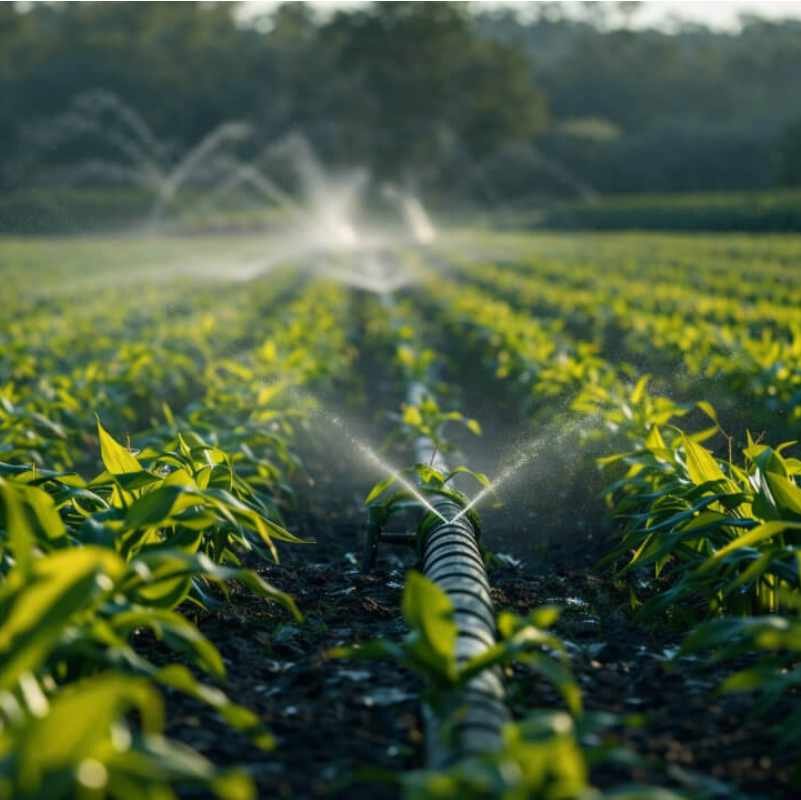
Cassava | Plantain | Maize | Yam | Cocoa | Palm Oil | Peppers | Tomatoes
Irrigation Is the Backbone of Our Agribusiness Model
At Triadola Farms and Agro Processing Limited, irrigation is not an optional enhancement. It is core infrastructure.
In Nigeria, many agricultural operations remain dependent on seasonal rainfall. This creates production gaps, inconsistent quality, idle processing capacity, and volatile revenue cycles.
Triadola operates a structured irrigation system that enables:
- Year-round crop cultivation
- Predictable harvest cycles
- Improved crop uniformity
- Reduced climate exposure
- Stable raw material supply for processing
Irrigation transforms farming from rainfall-dependent production into a controlled supply system.
Our Irrigation Infrastructure
Triadola integrates a practical and resilient irrigation mix, including:
- oreholes for independent water access
- Solar-powered pumping systems for energy resilience
- Drip irrigation for precision water delivery
- Sprinkler systems for uniform field coverage
- Field-level water management planning
This layered infrastructure reduces dependency on unstable rainfall patterns and grid electricity disruptions.
Solar pumping strengthens operational continuity while lowering exposure to fuel price volatility.
Year-Round Production Across Our Value Chains
Irrigation directly supports production stability across:
- Cassava (Garri)
- Plantain
- Maize
- Yam
- Cocoa (early-stage establishment support)
- Palm Oil (young crop support)
- Peppers
- Tomatoes
For horticultural crops such as tomatoes and peppers, irrigation enables dry-season production when market demand is strong and supply is limited.
For staple crops such as cassava, maize, and yam, irrigation strengthens crop establishment and reduces drought-related losses.
For tree crops such as cocoa and palm, irrigation supports early-stage resilience and long-term productivity.
Production-Level Advantages
Irrigation allows Triadola to control one of agriculture’s most critical inputs: water timing and consistency.
This improves:
- Seedling establishment
- Root development
- Nutrient uptake efficiency
- Crop uniformity
- Reduced stress during dry spells
- Lower field-level losses
Uniform crops translate into fewer rejects during grading and more consistent processing performance.
Processing & Throughput Stability
Triadola integrates cultivation with agro-processing and packaging. Processing plants depend on steady raw material flow.
Irrigation supports:
- Predictable harvest volumes
- Reduced idle processing periods
- Improved labor planning
- Better equipment utilization
- Stronger margin stability
Instead of seasonal production spikes followed by downtime, irrigation supports smoother throughput cycles.
For investors, this improves asset utilization.
For buyers, it strengthens supply continuity.
Dry-Season Production Advantage
In many Nigerian markets, agricultural prices rise during dry seasons due to reduced supply.
Triadola’s irrigation systems allow us to:
- Produce during scarcity periods
- Avoid forced sales during market gluts
- Improve pricing leverage
- Support structured offtake agreements
This strengthens revenue stability and commercial positioning.
Climate Risk Mitigation
Rainfall variability is one of the largest risks in agriculture.
Irrigation reduces:
- Missed planting windows
- Crop failure from dry spells
- Uneven maturation
- Yield volatility
- Revenue concentration risk
For lenders and development finance institutions, irrigation materially reduces production uncertainty and strengthens bankability.
Irrigation and Quality Control
Water management directly affects crop quality.
With controlled irrigation, Triadola improves:
- Fruit uniformity (peppers and tomatoes)
- Grain consistency (maize)
- Root size stability (cassava and yam)
- Overall grading performance
Quality stability strengthens buyer retention and reduces rejection rates.
Strengthening Long-Term Scalability
Irrigation supports scalable expansion by:
- Making crop calendars predictable
- Improving agronomic data tracking
- Supporting measurable yield optimization
- Reducing weather dependency
Controlled production cycles allow capital investments in processing and packaging to operate more efficiently.
This turns agriculture into a **structured operating system**, not a seasonal gamble.
Irrigation and ESG Alignment
Irrigation infrastructure, particularly solar-powered pumping, supports:
With controlled irrigation, Triadola improves:
- Climate resilience
- Energy efficiency
- Water-use optimization
- Sustainable production practices
This aligns with ESG investment frameworks and development finance priorities focused on resilience and local value addition.
Why Irrigation Should Matter to Enterprise Buyers
For commercial buyers, irrigation means:
- Reduced supply disruption
- More consistent specifications
- Improved contract reliability
- Better forward planning
- Lower emergency sourcing costs
We are positioned as a dependable supplier rather than a seasonal supplier.
The Foundation of an Integrated Agro-Allied Platform
Triadola’s irrigation infrastructure connects:
Cultivation → Stable Harvest → Processing Throughput → Packaging → Commercial Delivery
It protects every stage of the farm-to-market chain.
Without irrigation, agriculture is seasonal.
With irrigation, it becomes structured, predictable, and scalable.
Lorem ipsum dolor sit amet, porro quisquam est, qui dolorem ipsum quia dolor sit amet.